Service Discovery
SMG automatically discovers and registers workers in Kubernetes environments, eliminating manual worker URL management and enabling dynamic scaling.
Overview
Native Kubernetes
Watch pods matching label selectors with automatic registration and removal.
Dynamic Scaling
Workers are automatically added and removed as pods scale up or down.
Label Selectors
Target specific workers using Kubernetes label selectors.
PD Support
Separate discovery for prefill and decode workers in disaggregated deployments.
How It Works
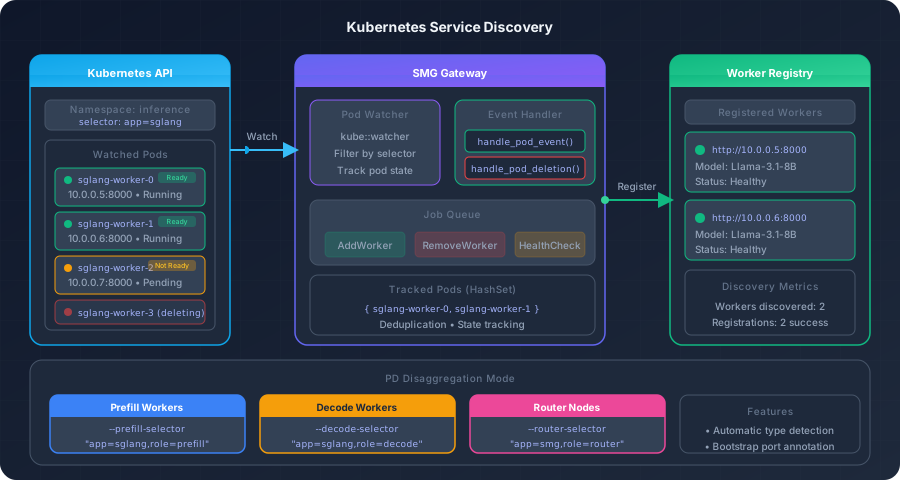
Discovery Flow
- Watch Pods: SMG creates a Kubernetes watcher for pods matching the configured label selector
- Filter Events: Only pods matching the selector (regular or PD mode) are processed
- Handle Events: Pod creation triggers
AddWorkerjob, deletion triggersRemoveWorkerjob - Register Workers: Workers are added to the registry with health checks starting immediately
- Track State: A HashSet tracks discovered pods to prevent duplicate registrations
Configuration
Basic Setup
smg \
  --service-discovery \
  --selector app=sglang-worker \
  --service-discovery-namespace inference \
  --service-discovery-port 8000
Parameters
| Parameter | Default | Description |
|---|---|---|
--service-discovery | false | Enable Kubernetes service discovery |
--selector | - | Label selector for worker pods (required) |
--service-discovery-namespace | (all namespaces) | Kubernetes namespace to watch |
--service-discovery-port | 80 | Port to use for worker connections |
Label Selectors
SMG uses Kubernetes label selectors to identify worker pods.
Simple Selector
Match pods with a single label:
Matches pods with label app=vllm.
Multiple Labels
Match pods that carry several labels by passing multiple key=value pairs:
Matches pods with both app=sglang AND environment=production.
PD Disaggregation Discovery
For prefill-decode disaggregated deployments, use separate selectors for each worker type.
Configuration
smg \
  --service-discovery \
  --pd-disaggregation \
  --prefill-selector app=sglang role=prefill \
  --decode-selector app=sglang role=decode \
  --service-discovery-namespace inference
Parameters
| Parameter | Description |
|---|---|
--prefill-selector | Label selector for prefill workers |
--decode-selector | Label selector for decode workers |
Worker Labels
Label your pods appropriately:
# Prefill worker
apiVersion: v1
kind: Pod
metadata:
  name: sglang-prefill-0
  labels:
    app: sglang
    role: prefill
spec:
  containers:
    - name: sglang
      image: lmsysorg/sglang:latest
      args: ["--dp-size", "1", "--prefill-only"]

---
# Decode worker
apiVersion: v1
kind: Pod
metadata:
  name: sglang-decode-0
  labels:
    app: sglang
    role: decode
spec:
  containers:
    - name: sglang
      image: lmsysorg/sglang:latest
      args: ["--dp-size", "1", "--decode-only"]
Required RBAC
SMG needs permissions to watch pods in the target namespace.
Role
apiVersion: rbac.authorization.k8s.io/v1
kind: Role
metadata:
  name: smg-discovery
  namespace: inference
rules:
  - apiGroups: [""]
    resources: ["pods"]
    verbs: ["get", "list", "watch"]
RoleBinding
apiVersion: rbac.authorization.k8s.io/v1
kind: RoleBinding
metadata:
  name: smg-discovery
  namespace: inference
subjects:
  - kind: ServiceAccount
    name: smg
    namespace: inference
roleRef:
  kind: Role
  name: smg-discovery
  apiGroup: rbac.authorization.k8s.io
ServiceAccount
Cross-Namespace Discovery
To discover workers across multiple namespaces, use a ClusterRole:
apiVersion: rbac.authorization.k8s.io/v1
kind: ClusterRole
metadata:
  name: smg-discovery
rules:
  - apiGroups: [""]
    resources: ["pods"]
    verbs: ["get", "list", "watch"]
---
apiVersion: rbac.authorization.k8s.io/v1
kind: ClusterRoleBinding
metadata:
  name: smg-discovery
subjects:
  - kind: ServiceAccount
    name: smg
    namespace: inference
roleRef:
  kind: ClusterRole
  name: smg-discovery
  apiGroup: rbac.authorization.k8s.io
Complete Deployment Example
SMG Deployment
apiVersion: apps/v1
kind: Deployment
metadata:
  name: smg
  namespace: inference
spec:
  replicas: 1
  selector:
    matchLabels:
      app: smg
  template:
    metadata:
      labels:
        app: smg
    spec:
      serviceAccountName: smg
      containers:
        - name: smg
          image: ghcr.io/lightseekorg/smg:latest
          args:
            - --service-discovery
            - --selector=app=sglang-worker
            - --service-discovery-namespace=inference
            - --service-discovery-port=8000
            - --policy=cache_aware
          ports:
            - containerPort: 8000
              name: http
Engine images
For all-in-one deployments where each pod runs both gateway and engine, use an engine image tag (e.g., ghcr.io/lightseekorg/smg:{smg_version}-{engine}-{engine_version}). See Getting Started for available tags.
Worker StatefulSet
apiVersion: apps/v1
kind: StatefulSet
metadata:
  name: sglang-worker
  namespace: inference
spec:
  serviceName: sglang-worker
  replicas: 3
  selector:
    matchLabels:
      app: sglang-worker
  template:
    metadata:
      labels:
        app: sglang-worker
    spec:
      containers:
        - name: sglang
          image: lmsysorg/sglang:latest
          args:
            - --model-path=meta-llama/Llama-3.1-8B-Instruct
            - --port=8000
          ports:
            - containerPort: 8000
Worker Lifecycle
Registration Flow
- Pod Created: Kubernetes creates a new worker pod
- Watch Event: SMG receives the pod creation event
- Capability Query: SMG queries the worker's
/model_infoendpoint (falling back to the deprecated/get_model_infoif the new path returns 404) - Registration: Worker is added to the registry
- Health Check: Background health checks begin
Removal Flow
- Pod Terminating: Kubernetes begins pod termination
- Watch Event: SMG receives the pod deletion event
- Drain: SMG stops sending new requests to the worker
- Removal: Worker is removed from the registry
Worker States
| State | Description | Receives Traffic |
|---|---|---|
| Pending | Just registered, not yet proven healthy locally | No |
| Ready | Locally verified and passing health checks | Yes |
| NotReady | Previously Ready, now failing readiness checks; not removed unless configured | No |
| Failed | Sustained liveness failure; removed when --remove-unhealthy-workers is set | No |
Monitoring
Metrics
| Metric | Description |
|---|---|
smg_discovery_workers_discovered | Workers known via discovery |
smg_discovery_registrations_total | Worker registration events |
smg_discovery_deregistrations_total | Worker deregistration events |
smg_discovery_sync_duration_seconds | Duration of each periodic reconciliation cycle |
Logs
Example log output:
[INFO] Watching pods in namespace 'inference' with selector 'app=sglang-worker'
[INFO] Discovered new pod: sglang-worker-0 (10.0.0.5:8000)
[INFO] Registered worker: http://10.0.0.5:8000
[INFO] Discovered new pod: sglang-worker-1 (10.0.0.6:8000)
[INFO] Registered worker: http://10.0.0.6:8000
Troubleshooting
| Symptom | Cause | Solution |
|---|---|---|
| No workers discovered | Wrong selector | Verify labels match selector |
| RBAC error | Missing permissions | Apply Role and RoleBinding |
| Workers not ready | Health check failing | Check worker health endpoint |
| Stale workers | Watch disconnected | Check Kubernetes API connectivity |
Verify Discovery
# Check discovered workers via admin API
curl http://smg:30000/workers | jq

# Check pod labels match selector
kubectl get pods -n inference -l app=sglang-worker

# Verify RBAC
kubectl auth can-i watch pods -n inference --as=system:serviceaccount:inference:smg